GRAC CZY NIE GRAĆ — oto jest pytanie…
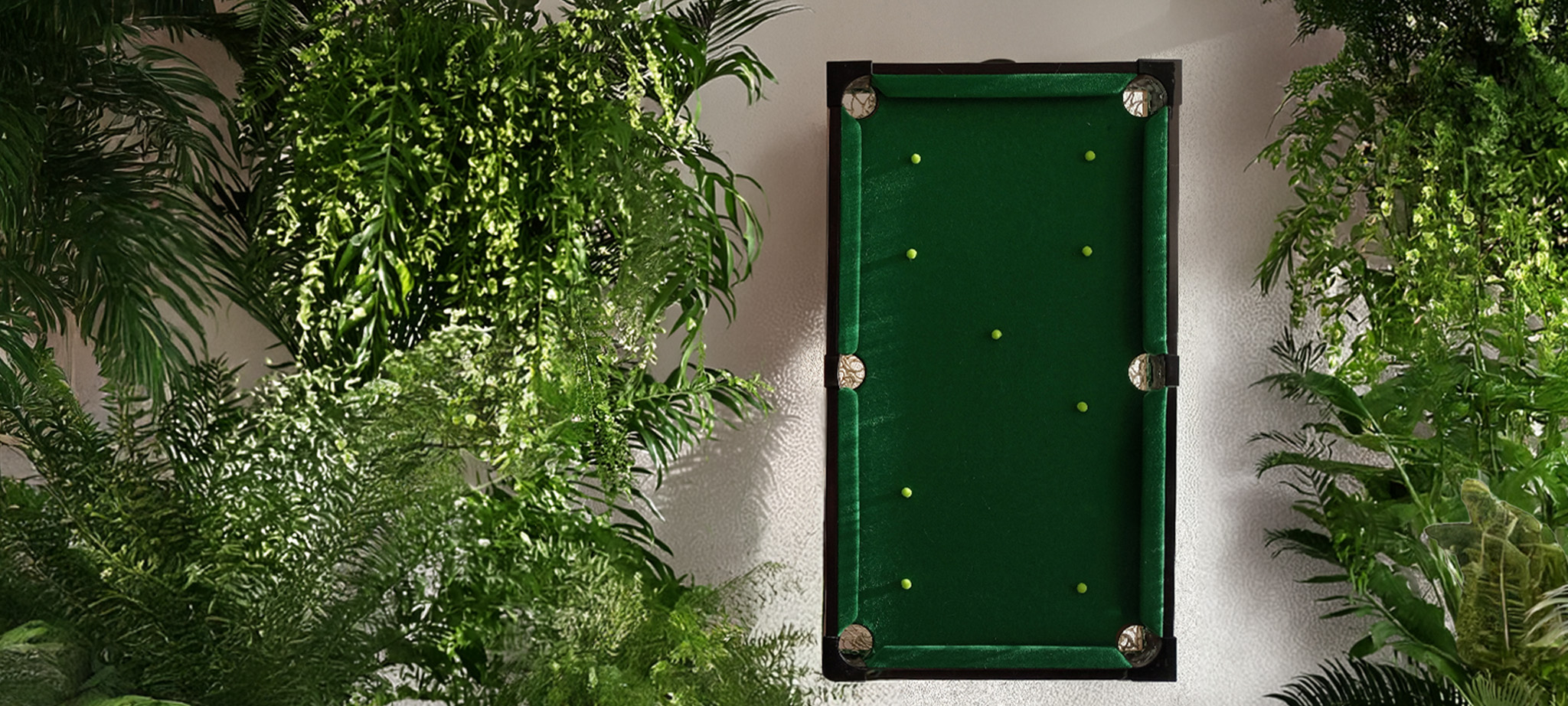
„Game or not to game” jest pracą o grze, która paradoksalnie pozbawiona została możliwości wykonania ruchu. Miniaturowy stół bilardowy — obiekt jednoznacznie związany z regułą, strategią, przypadkiem i rywalizacją — staje się tutaj zamkniętym układem. Umieszczone na jego powierzchni punkty, przypominające kule bilardowe, tworzą predefiniowaną konfigurację. Ich położenie nie może zostać zmienione. Zamiast potencjalności ruchu pojawia się więc jego brak; zamiast rozgrywki — jej scenografia.
Tytuł pracy, będący przekształceniem słynnej frazy z Hamleta, przesuwa akcent z pytania o samo istnienie gry na pytanie o możliwość uczestnictwa w niej.
Czy sytuacja, w której wszystkie pozycje zostały już ustalone, nadal może być nazywana grą? A jeśli grą jest, to kto właściwie jest jej graczem?
Praca zawiesza się pomiędzy przypadkiem a determinizmem, strategią a bezruchem, wyborem a jego pozorem.
Bilard jest tu także modelem świata społecznego: systemem relacji, w którym ruch jednego elementu może zmienić położenie pozostałych. Jednak w prezentowanym układzie ta podstawowa zasada zostaje unieważniona. „Kula” nie może zostać uderzona, pozycja nie może zostać zakwestionowana, a uczestnik nie może dopisać własnego gestu do istniejącej konfiguracji. Sprawczość zostaje zastąpiona możliwością obserwacji.
W tym sensie praca dotyka współczesnego doświadczenia politycznego: poczucia funkcjonowania wewnątrz struktur, których reguły, role i możliwe ruchy zostały określone wcześniej. Postacie takie jak Donald Trump czy Władimir Putin mogą zostać przywołane jako figura „gracza”, dla którego rzeczywistość staje się przestrzenią strategicznych posunięć — podczas gdy inni występują w niej jako elementy podlegające przesunięciu. Nie chodzi jednak o prostą analogię między polityką a bilardem, lecz o pytanie o ASYMETRIĘ SPRAWCZOŚCI: kto może wykonać ruch, kto ustala reguły, a kto pozostaje jedynie figurą na planszy.
„Game or not to game” można więc odczytać jako MODEL SYTUACJI W KTÓREJ SAMA MOŻLIWOŚĆ DZIAŁANIA STAJE SIĘ PRZEDMIOTEM GRY. Praca pyta o motywację do wykonania ruchu, gdy jego skuteczność jest niepewna, o odpowiedzialność za ruch, którego konsekwencji nie można przewidzieć, oraz o różnicę między uczestnictwem a jedynie zajmowaniem wyznaczonego miejsca. Ostatecznie bilardowy stół przestaje być stołem do gry, a staje się SCENĄ DRAMATU O SPRAWCZOŚCI — planszą, na której najważniejszym elementem nie jest ruch, lecz pytanie, czy ruch w ogóle pozostaje możliwy.
Game or not to game stages a game in which the possibility of making a move has been paradoxically withdrawn. A miniature billiard table—an object intrinsically associated with rules, strategy, chance, and competition—becomes a closed system. Points resembling billiard balls are arranged in a predefined configuration, yet their positions cannot be altered. What remains is not the potential for movement, but its absence; not the game itself, but its scenography.
The title, a transformation of the famous phrase from Shakespeare’s Hamlet, shifts the question from whether a game exists to whether participation in it is still possible.
Can a situation in which all positions have already been determined still be called a game? And if it is a game, who, precisely, is playing it?
The work suspends itself between chance and determinism, strategy and stasis, choice and the appearance of choice.
The billiard table also operates as a model of the social world: a system of relations in which the movement of one element can alter the position of others. Yet here, this fundamental principle is suspended. The “ball” cannot be struck, a position cannot be contested, and the participant cannot introduce a new gesture into the existing configuration. Agency is replaced by the possibility of observation.
In this sense, the work addresses a contemporary political condition: the experience of operating within structures whose rules, roles, and possible moves have been established in advance. Figures such as Donald Trump or Vladimir Putin can be invoked here as embodiments of the “player”—one for whom reality becomes a field of strategic manoeuvring, while others appear as elements to be displaced. The analogy is not intended as a straightforward equation between politics and billiards, but rather as an exploration of ASSYMETRIES OF AGENCY: who is able to make a move, who determines the rules, and who is left occupying a predetermined position.
Game or not to game can therefore be read as a
model of a situation in which the very possibility of action becomes the object of the game.
The work asks what motivates a move when its efficacy remains uncertain; where responsibility lies when the consequences of a move cannot be anticipated; and what distinguishes participation from merely occupying an assigned place.
Ultimately, the billiard table ceases to function as a gaming device and becomes A STAGE FOR A DRAMA OF AGENCY—a playing field on which the most consequential element is not movement itself, but the question of whether movement remains possible at all.